
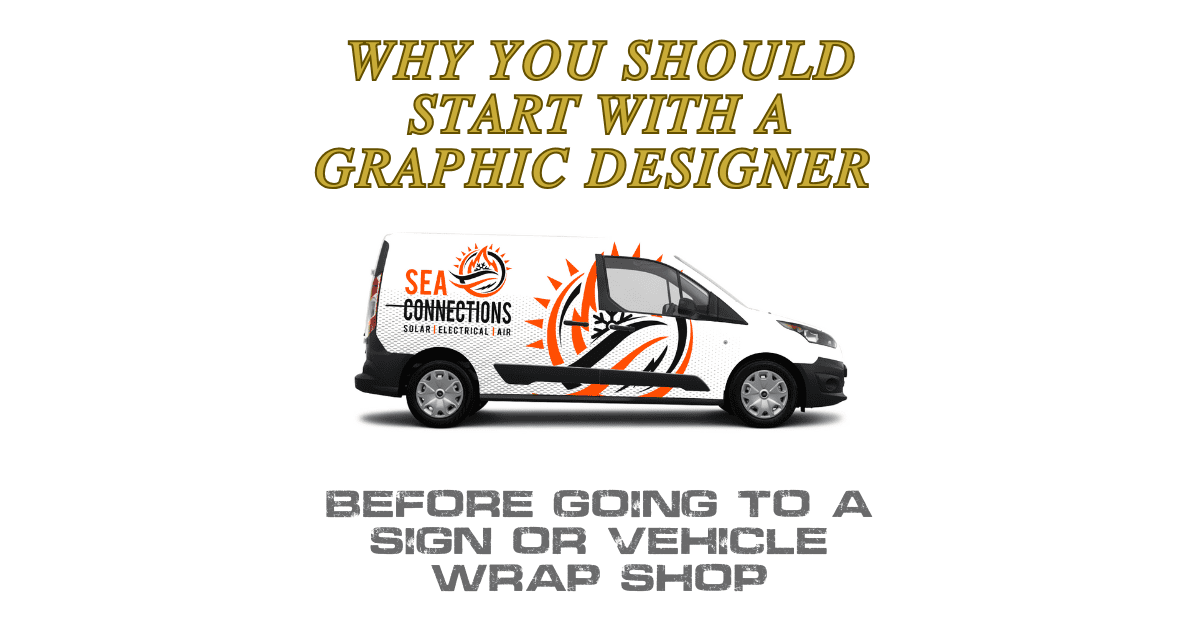
Why Starting With Design Matters
Choosing where a project begins affects quality, cost, and long-term consistency. Many businesses go directly to a sign or wrap shop expecting design services. These shops excel at printing and installation, but design is often secondary to production speed.
A graphic designer approaches the project with intent and structure before production constraints are introduced.
The Difference Between Design and Production
Sign and wrap shops operate in production-driven environments. Their focus is materials, equipment setup, and installation efficiency. Design support is usually limited to basic layout work needed to move a job into fabrication.
A graphic designer focuses on visual hierarchy, layout logic, readability, and brand alignment. These decisions are difficult to correct once production begins.
Cleaner Files Save Time and Money
Many production delays come from file issues rather than printing problems. Common issues include low-resolution artwork, incorrect color spaces, missing bleeds, improper scaling, and typography that fails at large sizes.
A designer delivers files prepared for large-format production, reducing revisions and preventing costly reprints.
Design for Real-World Conditions
Large-format graphics are viewed at distance, in motion, and under varying lighting conditions. Design choices must account for these realities.
Graphic designers consider viewing distance, contrast, font legibility, surface distortion, and panel breaks before files reach the printer.
Consistent Branding Across All Materials
When design is handled piecemeal, branding becomes inconsistent. One vendor handles signage, another vehicles, another print materials, each making independent design decisions.
A graphic designer creates a unified visual system that carries across signage, vehicle wraps, printed materials, and digital assets.
Why Sign Shops Prefer Designer-Prepared Files
Sign and wrap shops work more efficiently with finalized, production-ready files. Fewer questions and fewer revisions allow them to focus on materials, print quality, finishing, and installation.
This improves turnaround time and reduces friction.
Recommended Workflow
Graphic Designer Responsibilities
Concept development
Layout and visual hierarchy
Brand alignment
Print-ready file preparation
Sign or Wrap Shop Responsibilities
Material selection
Printing and fabrication
Finishing
Installation
Summary
Starting with a graphic designer improves clarity, consistency, and production efficiency. Sign and wrap shops remain essential partners, but design decisions should be finalized before production begins.

Ronnie Lee Roberts II is a part owner and principal of R.L. Roberts II Design, LLC, a design and documentation studio focused on production-ready graphics and structured compliance materials. His background combines quality management, technical documentation, and professional graphic design, supporting work built for operational use rather than presentation alone. His portfolio includes sign shop overflow support, naval base maps and facilities graphics, home service company materials, and custom compliance documentation, along with work for mission-driven organizations such as The Arc and United Way. His work emphasizes clarity, consistency, and efficiency across print, digital, and regulated environments.